
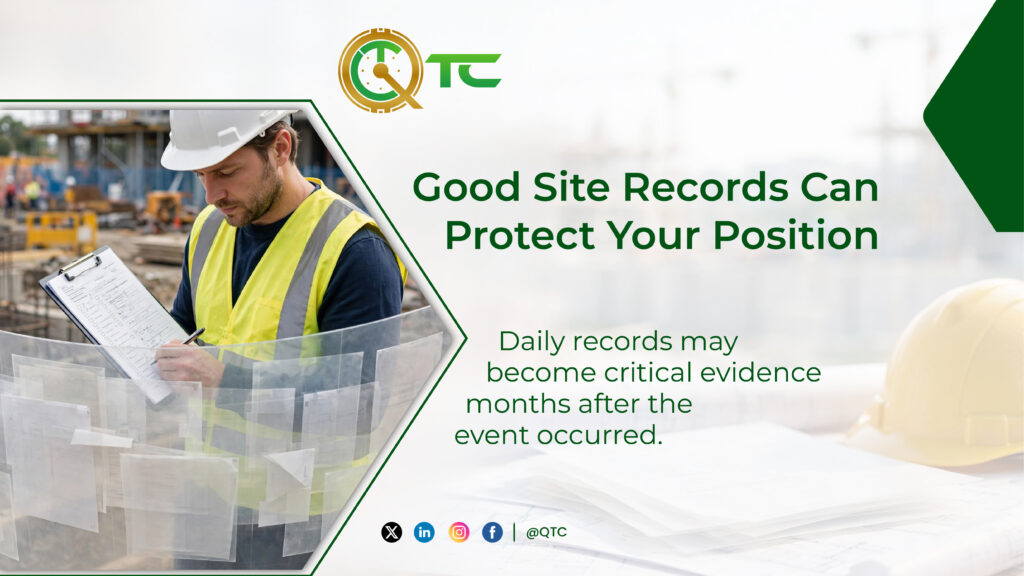
Why Good Site Records Can Protect Your Position
Quick answer: Good site records protect your position because daily records may become critical evidence months after an event occurred. Accurate, dated and factual records show what happened, when and why, which supports extension of time claims, loss and expense, variations and your defence if a dispute arises.
The building is handed over, the team moves on to the next job, and everything feels settled. Then, six months later, a letter arrives. There is a claim for delay or a dispute about who instructed a change or a final account that nobody agrees on.
Suddenly the question is not what you remember. It is what you can show.
That is the quiet power of good site records. They are rarely exciting to write at the end of a long shift, but they can be the difference between a position that is accepted and one that is dismissed for lack of evidence.
What Are Contemporaneous Site Records?
Contemporaneous records are notes, documents and images created at, or very close to, the time something happened. The closer to the event, the more credible they are. A diary entry written that evening says far more than a summary reconstructed months later from memory.
They include far more than a site diary. Think of them as the project’s running evidence file.
Why Daily Records Matter Months Later
Construction disputes are rarely argued while the work is under way. They surface during final accounts, at completion or long afterwards. By then, key people have changed roles, memories have blurred and the site looks nothing like it did.
Reliable records help in several situations:
- Extension of time and delay claims: delay analysis compares what was planned with what actually happened, so it depends on accurate progress and resource records.
- Loss and expense or compensation events: costs and effects usually need to be substantiated, not just asserted.
- Variations: records of instructions, changes and extra work show what was asked for and when.
- Defending a claim: good records can rebut an unfounded claim as effectively as they support a genuine one.
- Adjudication, arbitration and other ADR: tribunals and adjudicators weigh evidence and contemporaneous documents tend to carry weight.
A UK study in the Journal of Construction Engineering and Management found that one of the main obstacles to using delay analysis methods in practice was deficiencies in project records and scheduling practice. In other words, even good analysis struggles when the underlying records are weak.
What Should You Record?
- Daily site diaries: date, weather, location and work carried out.
- Labour and plant on site, including hours and idle time.
- Deliveries, material shortages and late or missing information.
- Instructions received, whether verbal, written or by email and who gave them.
- Dated progress photographs and, where useful, video.
- Delays, disruptions, access restrictions and interference by others.
- Meeting minutes, RFIs and responses.
- Programme updates and progress against the baseline.
- Safety incidents, inspections and test results.
- Records of notices given and received.
What Does a Good Record Look Like?
- Dated and timed: including who wrote it and where it relates to.
- Factual: what was seen and done, not opinion or blame.
- Specific: activities, areas, numbers of people, hours and quantities.
- Linked: to the programme, drawing, instruction or change it relates to.
- Consistent: kept every day, not only when something goes wrong.
- Protected: signed or attributed, backed up and never overwritten.
Vague vs Useful: A Quick Example
A weak entry: “Rain. Work delayed.”
A stronger entry: “Heavy rain 08:00 to 13:30. Groundworkers (6 operatives) unable to pour slab to Grid B-D. Excavator on standby for 5.5 hours. Pour moved to the following day. Photos 14 and 15 attached. Site manager informed at 08:20.”
The second version names the activity, the resources, the duration and the effect. It gives someone assessing the delay something concrete to work with.
Common Mistakes That Weaken Your Position
- Writing records weeks later from memory.
- Vague entries with no activity, area or duration.
- Recording only problems, which makes the record look selective.
- Scattering evidence across personal phones, chats and notebooks.
- Failing to link instructions, changes and delays to the programme.
- Missing contractual notice deadlines.
Records and Notice Requirements
Records and notices work together. Many contracts, including NEC, JCT and bespoke forms, set time limits for notifying delays, compensation events and claims. Missing a notice can put a claim at risk, however good the underlying evidence may be. Check your contract for its specific requirements and take advice early if you are unsure.
How Digital Tools and AI Are Changing Site Records in 2026
Teams now capture timestamped, geotagged photos on phones, keep diaries in cloud apps and store drawings and information in shared digital environments. For higher-risk buildings in England, the golden thread requirement has also raised expectations around information management. AI tools can summarise long diaries or help search large document sets.
These tools make records easier to capture and find, but they do not replace accuracy. An AI summary is only as good as the original entries and a photo means little without a date, location and explanation. Keep data protection in mind when photographing people and back up everything.
A 5-Minute End-of-Day Routine
- Complete the site diary while the day is fresh.
- Upload and label the day’s photos with location and activity.
- Log instructions received, and confirm verbal ones in writing.
- Note any delay, disruption or extra work and its likely effect.
- Back up the records and check that nothing was overwritten.
When Should You Involve a Construction Consultant?
The best time is before a problem becomes a dispute. Early advice on record keeping, notices, variations and dispute avoidance helps you build a stronger position from the start. QTC’s team of construction consultants supports clients across contract administration, variations, compensation events and claims, delay analysis, dispute avoidance and ADR preparation.
Frequently Asked Questions
What are contemporaneous site records?
They are records made at, or very close to, the time an event happened, such as daily diaries, progress photos, labour and plant returns, delivery notes, instructions and meeting minutes. Because they are written while events are fresh, they carry more weight than recollections written later.
Why do site records matter months after an event?
Claims, variations and disputes are often argued long after the work is finished. By then memories have faded and people have moved on, so the paper trail becomes the main evidence of what happened, when and who was responsible.
What should a daily site record include?
The date, location, weather, labour and plant on site, work carried out, deliveries, instructions received, visitors, delays, disruption and any safety incidents. Entries should be factual, specific and signed or attributed to the author.
How do site records support an extension of time claim?
Delay analysis compares what was planned with what actually happened. Accurate records of progress, resources and causes of delay give the analysis a reliable foundation, while poor records weaken it.
Do I need records to claim loss and expense or compensation events?
Generally, yes. Most contracts expect costs and effects to be substantiated, so records of resources, time, instructions and impact are what turn a claim from an assertion into something that can be assessed. Always check your own contract’s requirements.
Are photos and WhatsApp messages acceptable as site records?
They can be useful, particularly when dated and clearly linked to a location and event. However, scattered messages are hard to retrieve, so key information should also be captured in a structured, backed-up record.
What is the biggest mistake teams make with site records?
Writing them up weeks later from memory. Vague entries such as “delayed by weather” without details of what was affected and for how long rarely help when a position needs to be proved.
When should I involve a construction consultant?
As soon as a variation, delay or disagreement looks likely, rather than after it escalates. Early advice on record keeping, notices and dispute avoidance is usually far cheaper than resolving a dispute later.
Conclusion
Nobody finishes a long day on site excited to complete paperwork. But the few minutes you spend recording what happened can become the most valuable evidence on the project. Keep records dated, factual, specific and safe, and link them to instructions and the programme. When a question arises months later, you will not be relying on memory. You will be relying on proof.
Want to strengthen your position on a live project? Talk to QTC about contract and commercial support and ask about the free 30-minute consultation. This article is general information, not legal advice and you should always check your own contract.
For Further Assistance, Consult QTC!
Email: info@consultqtc.com
Contact: (+44) 1922 – 662248