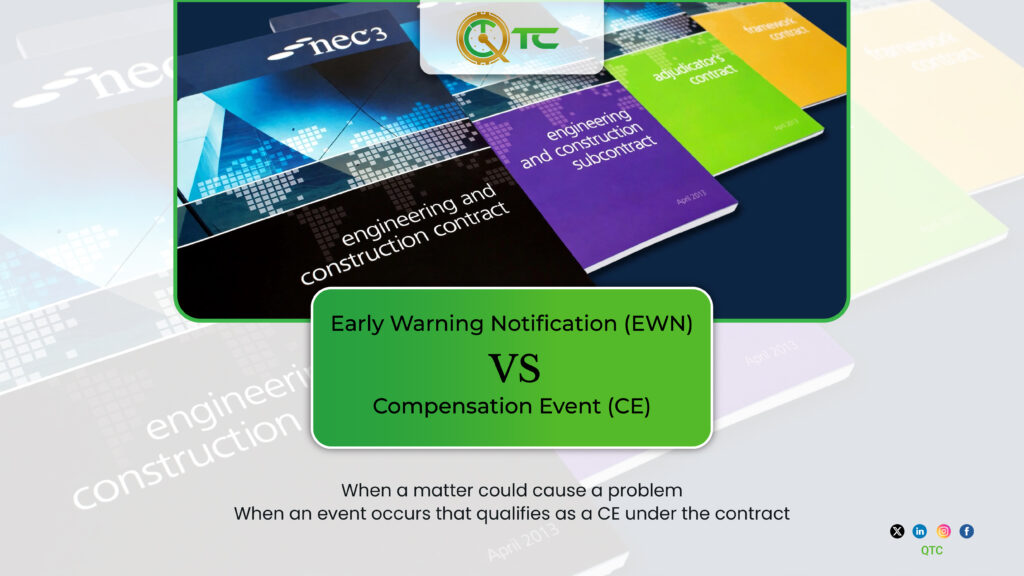
NEC Early Warning vs Compensation Event: What’s the Difference?
A variation or change happens on an NEC project. You recognise that it could affect cost or time. Did you give the right notice?
This is where Early Warnings and Compensation Events are often confused.
An NEC Early Warning and an NEC Compensation Event (CE) are not the same contractual process. An Early Warning is primarily a proactive risk-management mechanism, while a Compensation Event is a contractual mechanism for dealing with events that can change the Prices, Completion Date or other contractual outcomes. NEC’s own guidance confirms that an Early Warning may precede a Compensation Event, but it is not itself a Compensation Event notification.
That distinction matters because getting the right notice to the right party at the right time can affect how a project risk is managed and, in some circumstances, how a Compensation Event is assessed.
What is an NEC Early Warning?
An NEC Early Warning is a notification given when a party becomes aware of a matter that could affect the project.
Under NEC4 ECC, the Early Warning mechanism is found in Clause 15. Under NEC3 ECC, the corresponding provision is Clause 16. NEC describes the process as applying when a matter could increase the Prices, delay Completion or a Key Date or impair the performance of the works.
The important word is “could.”
You do not necessarily need to wait until the financial or programme impact is certain.
For example, a contractor may discover that information required for upcoming works has not yet been provided. The full impact may not be known, but the issue could affect productivity, cost or programme. That may warrant an Early Warning so the parties can discuss the risk and consider mitigation.
What is the purpose of an Early Warning?
The purpose is not simply to protect a future claim.
It is to encourage the parties to identify problems early and work together to reduce their potential effect.
An Early Warning can therefore help the project team:
- Identify emerging risks
- Discuss potential solutions
- Reduce delay
- Reduce additional cost
- Improve communication
- Consider alternative methods
- Record important project risks
- Trigger an Early Warning or risk-reduction meeting where applicable
The NEC process is deliberately designed around early communication rather than waiting until a problem has become a dispute.
What is an NEC Compensation Event?
A Compensation Event is a contractual event that can result in an adjustment to the Prices, Completion Date or other relevant contractual outcomes.
Under NEC4 ECC, Clause 60 identifies Compensation Events. NEC explains that a Compensation Event is the mechanism through which the cost and/or time consequences of qualifying events are dealt with under the contract.
Examples can include qualifying:
- Changes to the Scope
- Delayed access
- Certain physical conditions
- Certain failures by the Client or Others
- Certain Project Manager or Supervisor actions
- Events that are the Client’s liability
- Other events identified by the contract or Contract Data
The exact entitlement depends on the contract actually signed, including its main and secondary Options and any amendments.
So, simply having a cost or delay does not automatically mean that a Compensation Event exists.
The event must fall within the contractual mechanism.
NEC Early Warning vs Compensation Event: Key Differences
The easiest way to understand the distinction is to compare their purpose.
| Early Warning | Compensation Event |
|---|---|
| Primarily a risk-management mechanism | Contractual change/entitlement mechanism |
| Concerns a matter that could affect the project | Concerns an event that qualifies under the contract |
| Designed to encourage early action | Used to assess contractual time/cost consequences |
| Does not itself create Compensation Event entitlement | Can result in changes to Prices and/or Completion Date |
| May happen before a CE | May follow an Early Warning |
| Can concern a risk that ultimately does not become a CE | Must satisfy the applicable contractual provisions |
| Uses the Early Warning process | Uses the Compensation Event notification and assessment process |
The key point is simple:
An Early Warning is not a Compensation Event notification.
NEC specifically confirms that the two processes are separate.
Is an Early Warning the Same as a Compensation Event Notice?
This is one of the most important points for anyone administering an NEC contract.
Giving an Early Warning does not automatically notify a Compensation Event.
NEC’s own guidance gives an example where an Early Warning leads to a Project Manager’s instruction that subsequently becomes a Compensation Event. The Early Warning and Compensation Event processes remain separate and the relevant Compensation Event still needs to be dealt with through the applicable contractual process.
Why does this matter?
Imagine a contractor identifies a design issue that could affect the programme.
- The contractor gives an Early Warning.
- The parties discuss the issue.
- The Project Manager subsequently instructs a change to the Scope.
- That instruction may constitute a Compensation Event.
- The earlier Early Warning does not simply replace the required Compensation Event notification.
- The contractual steps still need to be followed.
When Should You Give an NEC Early Warning?
The safest approach is to consider the question:
Could this matter affect the Prices, Completion, a Key Date or the performance of the works?
If the answer is potentially yes, the Early Warning mechanism should be considered promptly.
Examples might include:
Design information risk
Required information may not be available when needed.
Access risk
A required work area may not become available when expected.
Physical condition risk
Site conditions appear materially different from what could reasonably have been expected.
Programme risk
A developing issue could affect planned activities or critical work.
Interface risk
Another party’s work could interfere with your planned activities.
The objective is to identify the issue early enough for the parties to do something about it.
When Should You Notify a Compensation Event?
This requires a different question:
Has an event occurred, and does the contract provide that it is a Compensation Event?
If so, the applicable notification procedure needs to be followed.
For NEC4, Clause 61 contains important notification and procedural provisions. Certain contractor-notified Compensation Events are subject to a contractual time limit, commonly associated with the eight-week period in Clause 61.3, but the executed contract and any amendments must always be checked before relying on a particular deadline.
This is why an Early Warning should not be treated as the end of the process.
A project team should continue monitoring the issue:
Risk identified → Early Warning → issue develops → determine whether a CE exists → notify CE → quotation/assessment → implementation
The exact sequence can vary depending on the event and contract provisions.
Can an Early Warning Become a Compensation Event?
The matter behind an Early Warning can subsequently lead to a Compensation Event, but the Early Warning itself does not become the Compensation Event notification.
For example:
- A contractor identifies a potential problem with site conditions.
- The contractor issues an Early Warning.
- The parties discuss mitigation.
- The actual conditions are encountered.
- The conditions satisfy the applicable Compensation Event provisions.
- The Compensation Event is notified and assessed under the contract.
The two processes are connected, but they are not interchangeable.
NEC describes an Early Warning as a matter that could happen and notes that it may precede a Compensation Event arising from the same matter.
What Happens If You Miss an Early Warning?
This is where the distinction becomes commercially important.
Under NEC4, if the contractor failed to give an Early Warning of an event that an experienced contractor could have warned about, the Compensation Event may be assessed as though the Early Warning had been given. NEC explains that this can result in a lower assessment because the assessment takes account of the mitigation that could have occurred with earlier warning.
In practical terms, failing to warn early can therefore create a financial consequence.
Example
Suppose a contractor becomes aware of a developing interface problem.
An experienced contractor could reasonably have warned the Project Manager.
No warning is given.
The problem later causes significant disruption and becomes a Compensation Event.
The assessment may consider what could have been avoided if the Early Warning had been given at the appropriate time.
The lesson is not simply:
“Give more notices.”
The better lesson is:
Identify contractual risks early and follow the correct contractual process for each event.
What Happens If You Miss a Compensation Event Notification?
This is a different issue.
A contractor may give an Early Warning but still fail to make the required Compensation Event notification.
That can create a serious procedural problem.
For certain NEC4 Compensation Events, Clause 61.3 contains a notification period, commonly eight weeks from becoming aware of the event. However, the precise contractual position must be checked against the executed contract and any amendments.
Therefore:
Early Warning ≠ CE notification
and:
Giving an Early Warning does not automatically preserve every Compensation Event entitlement.
This is one of the most important practical lessons for contract administrators.
NEC3 vs NEC4: Early Warning Differences
If you are working with NEC3, the clause numbering is different.
| Issue | NEC3 ECC | NEC4 ECC |
|---|---|---|
| Early Warning | Clause 16 | Clause 15 |
| Compensation Events | Section 6 | Section 6 |
| Relevant CE assessment provision | Clause 63.5 | Clause 63.7 |
| Early Warning terminology/process | Early Warning | Early Warning |
NEC’s official guidance confirms that Early Warning is dealt with under Clause 16 in NEC3 ECC and Clause 15 in NEC4 ECC.
This matters because an article or template written for NEC4 should not automatically be applied to an NEC3 project simply because the overall principles appear similar.
Always check the contract edition and amendments before relying on clause numbers or notification periods.
A Practical Example: Early Warning vs Compensation Event
Consider a construction project where a contractor discovers unexpected physical conditions during excavation.
Stage 1: The risk appears
The contractor identifies conditions that may affect productivity and excavation costs.
Potential action: Early Warning.
The issue is communicated before the full impact is known.
Stage 2: The conditions are confirmed
The physical conditions may satisfy the relevant Compensation Event provisions.
Potential action: Compensation Event notification.
Stage 3: The event is assessed
The applicable contractual process is followed to assess the effect on cost and time.
Stage 4: Records support the assessment
Contemporaneous records, programmes, site information, instructions, correspondence and cost information can become important in demonstrating what happened and when.
The important point is that the Early Warning helps manage the risk, while the Compensation Event process addresses the contractual consequences if the event qualifies.
What About a Variation or Change to the Scope?
This is particularly relevant to the question:
“A variation happened — did you give notice?”
NEC terminology is important here.
Rather than automatically treating every change as a traditional “variation” determine what the change represents under the particular NEC contract.
For example, under NEC4 ECC, a Project Manager instruction changing the Scope is one of the listed Compensation Events.
That means the project team should consider:
- What instruction or event occurred?
- When did it occur?
- What clause applies?
- Was an Early Warning required or appropriate?
- Does the event qualify as a Compensation Event?
- Who must notify?
- What is the applicable notification period?
- What records demonstrate the effect?
- How will the event be assessed?
This approach is much safer than simply labelling every change a “variation.”
Common NEC Early Warning and Compensation Event Mistakes
1. Treating an Early Warning as a CE notification
An Early Warning does not automatically replace the Compensation Event process.
Better approach: Track both processes separately and link them where the same matter is involved.
2. Waiting until the impact is certain
An Early Warning is designed for matters that could affect the project.
Waiting until the cost or delay is fully established can defeat the purpose of early risk management.
3. Assuming every Early Warning creates entitlement
It does not.
A risk can be real without being a Compensation Event.
The event must satisfy the relevant contractual provisions.
4. Giving an Early Warning but forgetting the CE notification
This can be particularly dangerous.
The Early Warning should trigger continued monitoring of the issue—not the assumption that the contractual process is complete.
5. Using the wrong NEC edition
Clause references differ between NEC3 and NEC4.
Always identify which contract and amendments apply.
6. Failing to maintain records
Good notification is only part of good contract administration.
The project team should also maintain appropriate records of:
- Notifications
- Instructions
- Programme effects
- Site events
- Correspondence
- Meetings
- Costs
- Resources
- Delays
- Mitigation
- Relevant contract dates
QTC’s Contract Administration Coaching specifically highlights notices, instructions, record keeping, procedural compliance, change control and evidence as core areas of effective contract administration.
How to Manage Early Warnings and Compensation Events Properly
A disciplined process can make a major difference.
1. Know the contract
Identify the applicable NEC edition, main Option, secondary Options, Contract Data and amendments.
2. Identify risks early
Ask regularly:
What could affect cost, time, Key Dates or performance?
3. Notify Early Warnings promptly
Do not wait unnecessarily for a fully developed impact.
4. Maintain an Early Warning Register
Use it to track outstanding risks, actions and meetings.
5. Review whether a risk has become an event
When circumstances change, reconsider whether a Compensation Event has arisen.
6. Check notification deadlines
Do not assume that an Early Warning protects you from separate Compensation Event notification requirements.
7. Preserve evidence
Maintain contemporaneous records supporting what happened, when it happened and what effect it had.
8. Assess the contractual consequences
Consider both cost and programme implications.
9. Close the loop
Do not leave Early Warnings or Compensation Events sitting indefinitely without clear ownership and follow-up.
This approach aligns closely with QTC’s stated approach to contract administration: structured processes, compliance monitoring and proactive management to reduce disputes and financial losses.
Why Contractual Notice Matters
Construction projects rarely fail because nobody knew that a problem existed.
More often, problems arise because the right information was not communicated through the right contractual process at the right time.
A team may know that:
- A design has changed
- Access has been delayed
- Ground conditions are different
- Another party is affecting the programme
- A Project Manager instruction has changed the work
But awareness alone is not necessarily enough.
The contractual procedure matters.
QTC identifies late notices, unclear instructions, weak records and poor communication as procedural failures that can create disputes, delay payments and expose organisations to unnecessary risk.
Conclusion
An Early Warning is about identifying and managing a potential problem. A Compensation Event is about dealing with a qualifying contractual event and its resulting time and/or cost consequences.
Do not assume that one notice automatically replaces the other.
When a change, risk or unexpected event occurs, ask:
- What happened?
- Could it affect the project?
- Is an Early Warning required or appropriate?
- Does the event qualify as a Compensation Event?
- What does the contract require me to notify, to whom and when?
- What records do I need to support the position?
The right entitlement can still become difficult if the contractual procedure is missed.
For organisations that need support with contract administration, change notifications, Compensation Events, claims and dispute avoidance, QTC provides post-contract services covering contract administration, contractual and commercial processes, and assistance with Variations/Compensation Events and claims.